GuideHow to Get a Drivers License in Texas 18+: Every Step, Every Fee
Founder & CEO · Smartyz Inc
On this page
Quick credibility note: I'm Abhi, Founder & CEO of Smartyz Inc, the company behind Get DMV Appointments. We poll all 235 Texas DPS offices every 10 seconds, so I watch this process at scale. Every fee and rule below was verified against dps.texas.gov on August 3, 2026.
TL;DR: one course, three tests, $33, one appointment
Getting a drivers license in Texas as an adult takes one course, three tests, and one appointment you will wait for. If you are 18 to 24, complete the state-required six-hour adult driver education course first; at 25 and older, that course is optional. Anyone taking the road test also watches the one-hour Impact Texas Adult Drivers video, and that certificate lasts just 90 days. Gather proof of identity, residency, lawful presence, and your Social Security number, then book a DPS appointment.
At the office you pass a vision exam, a knowledge test (70 percent to pass, waived by an approved course), and the driving test, then pay $33 for a license good for eight years. The card arrives by mail in 2 to 3 weeks. The tests are the easy part. The appointment is the bottleneck, and while the official scheduler is free, we typically find confirmed slots in 1 to 3 days for $29.99.
The paperwork takes one evening. Getting it right saves a second appointment.
Are you 18 or older and never licensed in any state?
This guide covers one situation. You are 18 or older, you live in Texas, and you have never held a driver license anywhere. That is the original, adult, Class C application. Three neighboring situations run on different rails, and following this guide for them will waste your time.
If you are under 18, Texas routes you through graduated driver licensing, and the under-18 path is a separate track with its own course hours and holding periods. Already licensed here and expiring soon? That is a renewal, not an original, and you may not need an office visit at all. Moving in with a valid out-of-state license? DPS waives both tests when you surrender it, and our Texas driver license requirements guide covers that transfer path.
Who's left is a bigger group than people assume. Adults who grew up carless in Houston or Dallas. New Texans never licensed back home. Twenty-somethings whose teenage paperwork stalled at step two. This is your article. One admin note from dps.texas.gov: if you carry a Texas ID card, you surrender it when you apply. You cannot hold both.
The six-hour course and the 90-day ITAD video
Two requirements gate everything else. If you are 18 to 24, Texas law requires a six-hour adult driver education course before you can apply for a first license. And anyone taking the road test must first complete the one-hour Impact Texas Adult Drivers (ITAD) video. Both certificates travel with you to the office.
The age split comes straight from DPS. There is no driver education requirement at 25 and older, while the Texas Driver Handbook ties the under-25 mandate to the Less Tears More Years Act. The ITAD rule is less forgiving. The certificate lasts exactly 90 days, and DPS's wording is blunt: you cannot take the test without it. Watch the video close to your test date, not the day you start planning. So book the appointment first, then watch the video once you have a date.
Documents are the other gate, and I'll keep this short because the full checklist lives in our requirements guide: proof of identity, lawful presence, Texas residency, and your Social Security number, plus proof of insurance for any vehicle you own. DPS's REAL ID Document Check tool builds you a personalized list. Use it.
One more thing most guides skip. You need legal practice time before any road test, and Texas handles that by issuing adults a Class C license with learner restrictions, meaning a licensed driver 21 or older with a year of experience beside you. If you have never driven, that practice comes before your road test, so treat the learner-restricted license as a separate earlier errand. Our learner permit page covers that path.
The six-hour course is self-paced. Most applicants finish the written exam inside it.
The written test needs 70 percent to pass
Texas publishes exactly one number for the Class C knowledge exam. You must score 70 percent or better to pass. Your study source is the Texas Driver Handbook, a free 91-page PDF from DPS with its own appendix of review questions. And many applicants under 25 never take this test at a DPS desk at all.
That last part surprises people. Applicants under 25 complete driver education anyway, and the handbook says finishing certain approved courses removes the office knowledge exam, so for many 18-to-24 applicants the written test happens at home, inside the six-hour course. At 25 and older you sit it at the office, same 70 percent bar. My preparation advice is boring, and it works. Read it once, front to back. Skimming a practice app teaches you the app, not the right-of-way rules the examiner will grade on your road test. If you fail, you can retest, but retests burn appointments, the one thing this process never has enough of.
The road test grades four skills, and parallel parking is one of them
You fail the Texas driving exam if more than 30 points are deducted, and the Texas Driver Handbook grades every driver on four basics: control, observation, positioning, and signaling. Points aside, the handbook lists three ways to fail outright: violating the law, refusing to follow instructions, and driving dangerously or having a crash.
The handbook also lists the specific maneuvers worth drilling before test day:
Where you take it is your choice: a DPS office, or a DPS-certified school under the Third Party Skills Testing (TPST) program. DPS does not regulate what those schools charge. Two gates apply either way. Your ITAD certificate must be dated within 90 days, and the exam is only given after you show evidence of insurance for the test vehicle, which must match the class of license you applied for. I don't know how individual examiners weight each maneuver; DPS doesn't publish that. I know what the handbook commits to, and the line is 30 points.
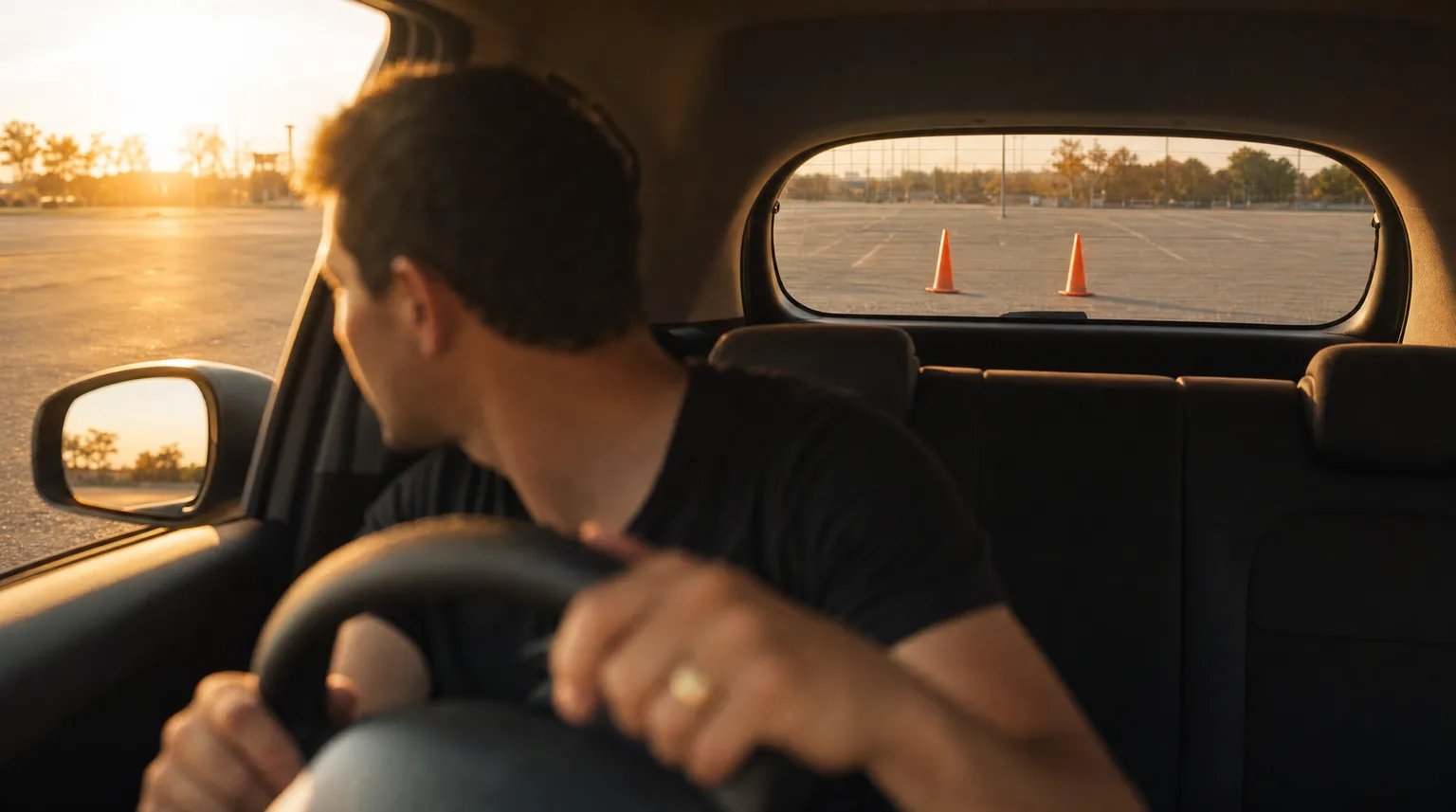
Sixty feet of straight backing and one clean parallel park cover the maneuvers applicants fear most.
What does the $33 cover at the office?
One visit covers everything if the paperwork is right. You complete the application, present your documents, give a signature and thumbprints, have your photo taken, pay the $33 fee, and pass a vision exam. Payment happens before any testing does. Then come the exams, the shortest part of the visit.
The vision exam is quick and consequential. Depending on the result, your license may carry a corrective-lens restriction, and an inconclusive reading gets you referred to your doctor. The fee is flat. $33 covers ages 18 to 84, includes the $1 administrative fee, and buys a license lasting eight years; replacements and other cases sit in our Texas DPS fees breakdown. Fail an exam and DPS holds your application for 90 days at no extra charge. Three failures, or 90 days elapsed, and you start over with a new application and another $33.
Now the part nobody budgets for. Getting inside the office is the hard part, and every DPS office appointment is issued by public.txdpsscheduler.com, ours included. Two things are worth reading before you fight it: how to make a Texas DPS appointment, and our guide to the scheduler itself. Skipping the appointment and walking into Texas DPS is a gamble.
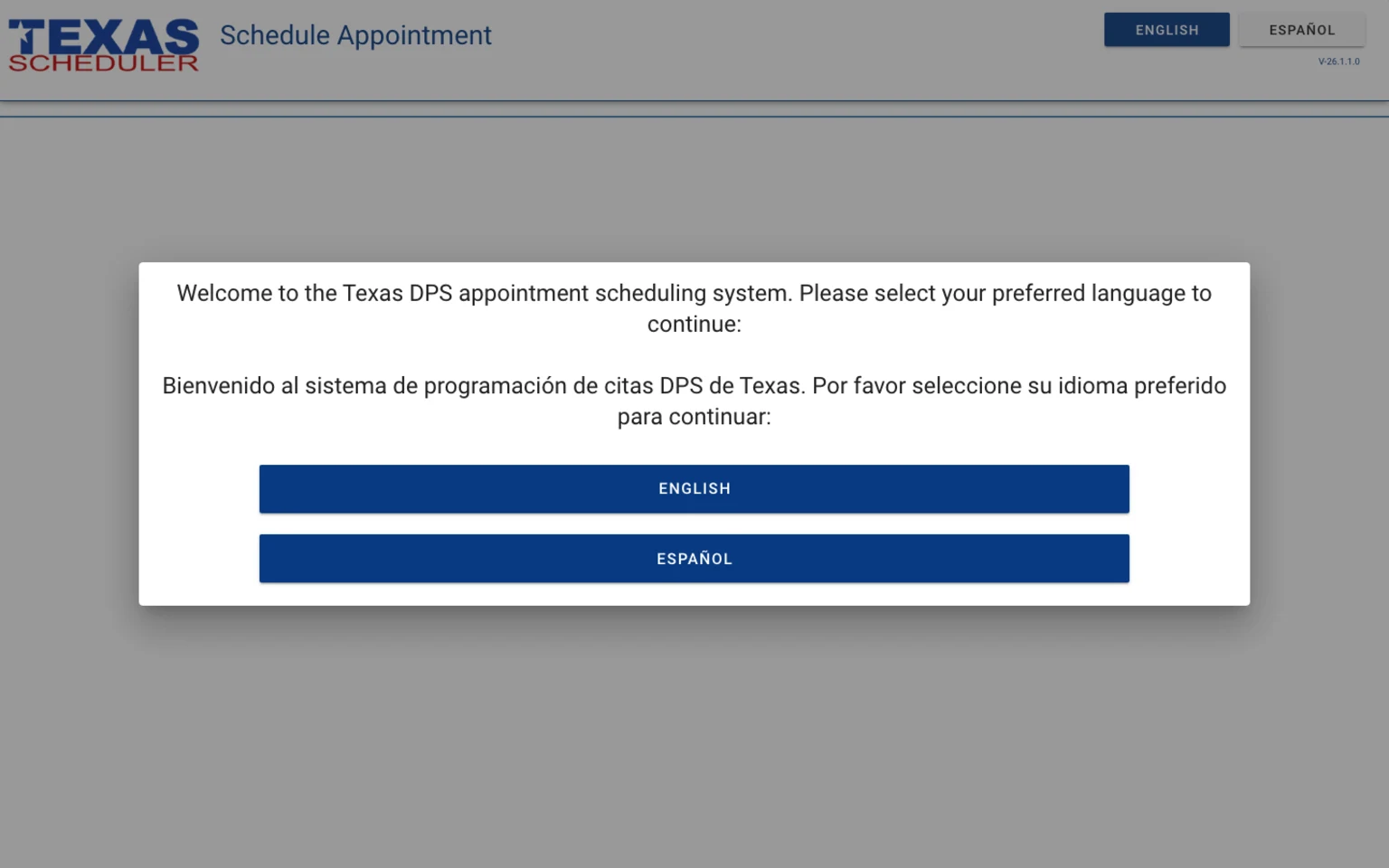
The official scheduler, exactly as it greets you. Free, first come first served, and cancellations vanish fast.
Card by mail in 2 to 3 weeks, and what can go wrong?
Pass everything and you leave the same day with a temporary paper license, valid for 45 days. The plastic card arrives by mail, typically within 2 to 3 weeks according to DPS. Proofread the temporary before you leave the counter, because an error printed there follows you onto the card.
The failure modes deserve equal billing, because I would rather you avoid a second trip. An ITAD certificate that quietly expired at day 91. A missing residency document. No proof of insurance for the test vehicle. A name that does not match across documents after a marriage or a move. None of these are rare, and every one costs the same thing, another appointment. DPS runs a mailing status page; if week three passes with an empty mailbox, check there first. What to bring on the day is worth a read the night before.
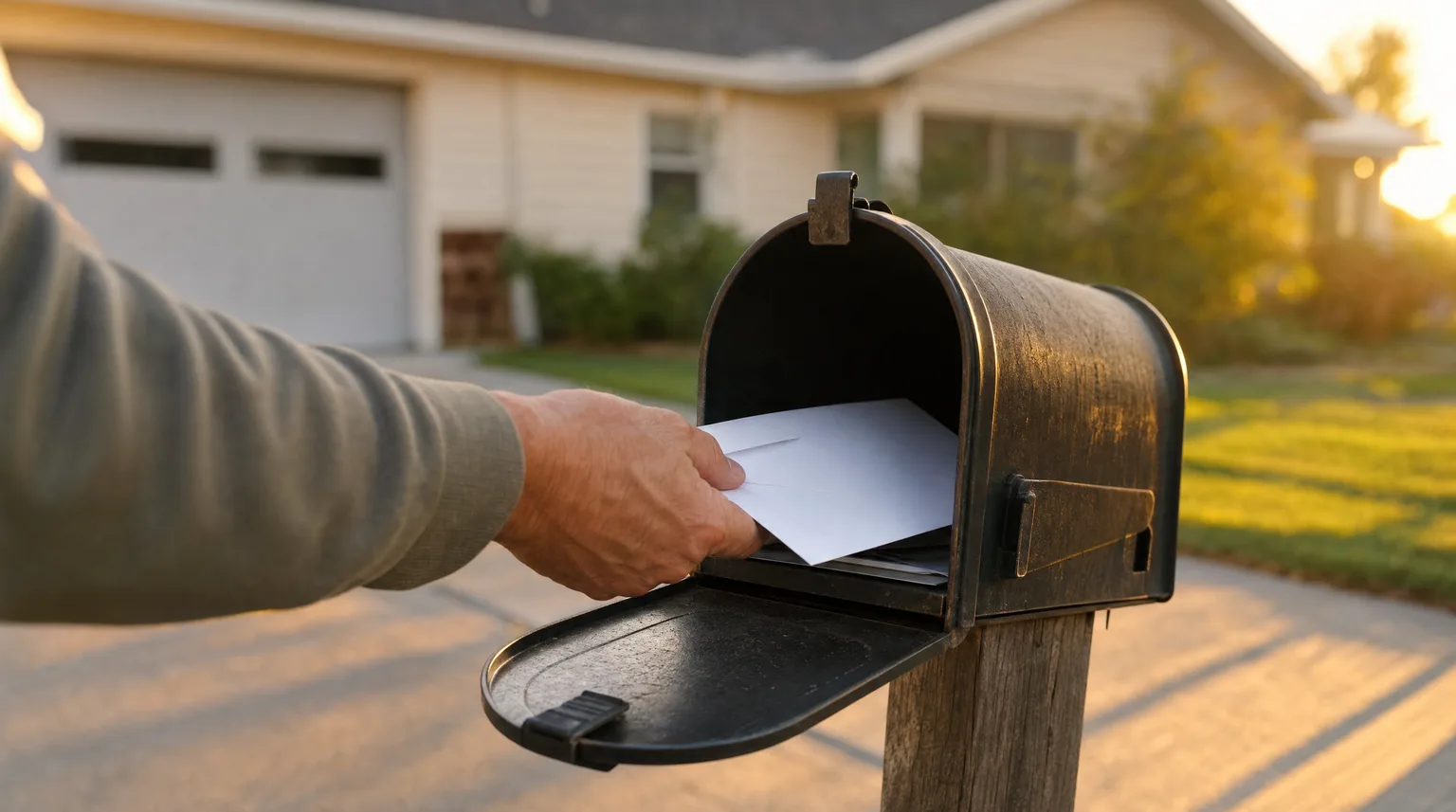
Two to three weeks, according to DPS. The temporary paper license covers you until it lands.
How Get DMV Appointments compares: the moment you look vs every 10 seconds
One difference matters most. The official scheduler shows you what is open at the moment you look. We watch every DPS office inside the radius you set from your home address, all at once, around the clock.
Booking is the headline. The $29.99 from Get DMV Appointments also covers:
Honest disclosure: I'm the founder of Get DMV Appointments, which is the service we built around this exact problem. I'm not going to pretend $29.99 is cheaper than free. If you have the flexibility to keep checking the official scheduler, use it; everything in this guide works without us. What you are buying from us is the watching. We book through the same public.txdpsscheduler.com that anyone can use. No special access, no back door. My name is on this article, and every fee in it was verified against the DPS fee page the day it was written. We watch so you don't have to. Whether that is worth $29.99 is your math to do, not mine. Not affiliated with the Texas Department of Public Safety (DPS).
What to do next about your first Texas driver license
The order matters more than the effort. Do it in this sequence and one visit is usually enough.
The one step you cannot brute-force is the appointment. You can watch the official scheduler yourself for free, or start a search with us and we book the moment a matching slot opens, with a full refund within 7 days if you change your mind. Either way, Texas makes the rules clear. Now you know all of them.
Articles on this site are drafted with AI assistance and reviewed and approved by named human authors who take editorial accountability. Not affiliated with the Texas Department of Public Safety (DPS).
Frequently Asked Questions
How many mistakes are allowed on the driving test in Texas?
There is no fixed mistake count; there is a point budget. The Texas Driver Handbook says your application will not be approved if more than 30 points are deducted, and the examiner grades four skills throughout: control, observation, positioning, and signaling. Beyond the point budget, the handbook lists three automatic fails: violating the law, refusing to follow instructions, and driving dangerously or having a crash. Small errors cost points. Those three end the conversation.
Is parallel parking on the driving test in Texas?
Yes. Parallel parking appears on the handbook's list of skills you may be graded on, so practice it as if it were guaranteed. Two equipment rules matter here. You may use your vehicle's backup camera for parallel parking and backing, and you may not use an automated self-parking function. The examiner needs to see you park the car, not watch the car park itself.
How long is the driving test in Texas?
Shorter than the wait to take it. DPS does not publish an official duration for the Class C driving exam, so treat any "exactly 20 minutes" figure you read elsewhere as a guess. What is fixed is the content. You are graded on four skills plus set maneuvers: parallel parking, a quick stop, roughly 60 feet of backing. Budget your morning around the office visit, not the drive.
How much is the driving test in Texas?
At a DPS office, nothing beyond the license application itself. The $33 application fee for ages 18 to 84 covers your exams, and DPS holds the application for 90 days, so a failed attempt costs nothing extra until you fail three times or the window lapses. Driving tests at third-party driver education schools are priced by each school, and DPS states outright that it does not regulate those fees.
Can you take the written driving test online in Texas?
Effectively yes, if you are 18 to 24. The required six-hour adult driver education course is offered online by state-approved providers, and the Texas Driver Handbook confirms that completing certain approved courses removes the Class C knowledge exam at the office. At 25 and older the course is optional, and DPS ties the written-test waiver to a course certificate, so if you skip the course, plan on taking the test in person.
Can I drive myself to my driving test in Texas?
No. Until a license is issued you are not licensed to drive alone, and the handbook is specific about the logistics. A licensed driver must drive the car to the office and exam area, and if you are not issued a license that day, that same licensed driver must drive you away. Learner-restricted practice likewise requires a licensed driver 21 or older with a year of experience beside you.
What should you bring to the driving test in Texas?
Three items sink more road tests than bad parallel parking. Your Impact Texas Adult Drivers certificate, dated within the last 90 days. Evidence of insurance for the vehicle you are testing in. A road-legal vehicle that matches the class of license you applied for. Road-legal is a real checklist in the handbook: two license plates, front and rear, two working brake lights, electric turn signals, a horn audible at 200 feet, wipers, and a rearview mirror. Bring your application paperwork and payment receipt as well. The office-visit documents are a longer list, and our what-to-bring checklist covers every scenario.
How many questions are on the Texas driving test?
If you mean the written exam, DPS does not publish a question count on dps.texas.gov. Test-prep sites commonly list 30 questions, but the only number DPS itself commits to is the pass bar of 70 percent or better. If you mean the road test, it is not question-based at all. You are scored against a 30-point deduction budget across four graded skills.
Ready to Skip the Wait?
Stop refreshing the DPS website. Let us find and book your appointment in days, not months.
$29.99 one-time payment · Full refund guarantee