GuideTexas ID Appointment: Book a State ID Card Fast in 2026
Marketing Specialist · Smartyz Inc
Fact-checking and data analysis by Julie Gonzalez · Scheduling Analyst
On this page
Texas does not have a DMV. If you need a state ID card, you are dealing with the Department of Public Safety, the same agency that issues driver licenses, through the same scheduler and the same appointment queue.
That queue is the whole problem. The card itself costs $16, or $6 once you turn 60. Getting in front of someone to hand over your documents is what takes months.
If the DPS-versus-DMV distinction is new to you, start with our Texas DMV appointment guide. Si prefieres leer en español, tenemos una guía para programar tu cita del DPS.
Quick note on who wrote this: I'm Jason T, a marketing specialist at Smartyz Inc, the company behind Get DMV Appointments. My job is talking to people who need DPS appointments, and non-drivers are the group I hear from most: seniors who stopped driving, teenagers starting first jobs, people who get around on transit. Every fee, document and rule below was checked against the Texas DPS website on August 2, 2026, and the appointment figures come from our own system, which reads the state's daily availability report across 232 offices. Where DPS and popular advice disagree, I went with DPS. Fact-checking and the appointment-data analysis in this piece were done with Julie Gonzalez, our scheduling analyst, who works in that data daily. Last updated 2026-08-02.
TL;DR — Quick Answer
A Texas ID card costs $16 if you're 59 or younger and $6 if you're 60 or older, and a standard card is valid for six years. You book it through the state's own scheduler at public.txdpsscheduler.com. Texas has no DMV, so driver licenses and ID cards both run through the Department of Public Safety.
You'll need to prove four things: U.S. citizenship or lawful presence, your identity, your Social Security number, and Texas residency. Residency takes two printed documents, and one of them has to show you've lived here at least 30 days.
Timing is the part most people get wrong. Across 232 Texas offices the median wait for the next open appointment is 13 days as of early August 2026, but for renewals and replacements the range runs from same-day to 78 days depending where you look. Further down, a live block shows today's figure.
If you already know what you need and just want the slot, start with our Texas ID appointment service. If you want to understand the process first, keep reading.
A standard Texas ID card is valid for six years, whichever age bracket you fall into.
Who actually needs a Texas ID card?
A Texas ID card is the state-issued photo ID for Texans who don't hold a driver license. It proves identity for employment, voting, banking, medical visits and domestic flights, and DPS issues it rather than a DMV. Same plastic, same photo, same gold star if it's Real ID compliant — the front just reads Identification Card instead of Driver License.
From what comes through our inbox, these are the people who need one:
Photo ID is what a surrendered driver license leaves behind. Voting is one of the places it's needed most.
Book your Texas ID appointment in six steps
Here's the whole flow, start to finish. It takes about ten minutes if your documents are already in hand, and it costs nothing: the public scheduler is free, and every step below works without us.
One thing worth knowing before you start. These steps have you checking one office, then checking again tomorrow when nothing has opened. You can hand that part over instead. Tell us your preferences once and we watch every DPS office in Texas for you, then book the first slot that fits them. It's $29.99, paid once, and if we haven't booked you inside seven days Stripe refunds it automatically, with no form to fill in and no email to send. Let us find your appointment, or keep reading and do it yourself. Both routes end at the same counter.
Step 1: Go to the official scheduler. public.txdpsscheduler.com is the only place to book. It's free. Pick English or Español on the landing screen. Third-party sites that charge you for the scheduler itself are not DPS.
Step 2: Log on. This is where people stumble, so it's worth a picture.
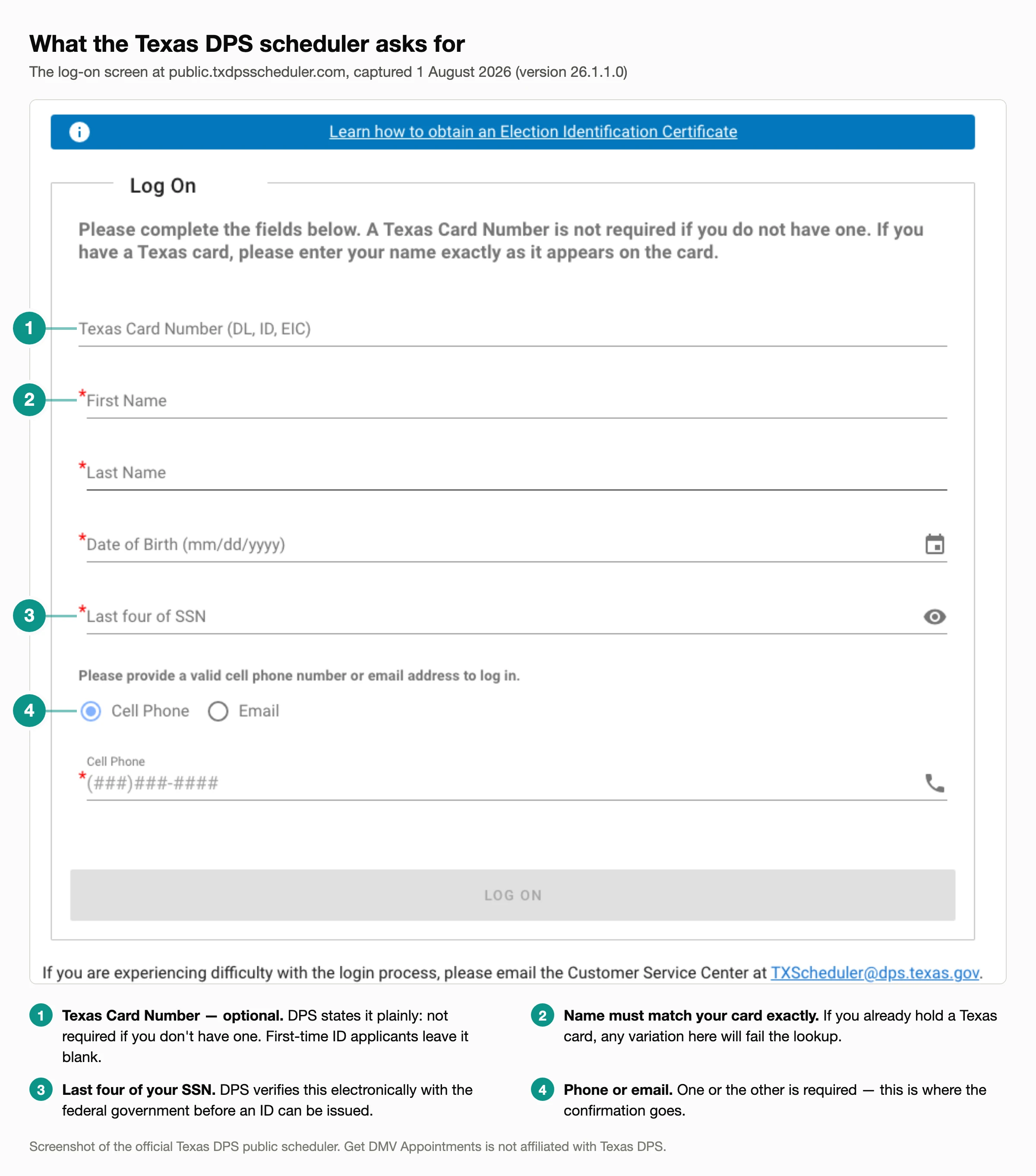
The log-on screen at public.txdpsscheduler.com, captured August 1, 2026.
The Texas Card Number field is optional. DPS says so directly on the screen: not required if you don't have one. First-time applicants leave it blank. If you do already hold a Texas card, your name has to match it exactly, character for character, or the lookup fails. You'll also give your date of birth, the last four of your Social Security number, and either a cell number or an email for the confirmation.
Step 3: Pick your service. Two matter here. For a first ID, choose Apply for first time Texas ID. For a card you already have, choose Change, replace or renew Texas ID. Those are the exact words on the menu, which is worth knowing, because a lot of write-ups quote names that don't exist.
Step 4: Choose an office. The scheduler shows availability per location. Do not stop at the closest Mega Center. More on this below, because it is where most of the waiting is created.
Step 5: Pick a date. You'll see what's actually open at that office. If everything is months out, that's normal at the big metro offices and it is not your only option — go back and compare other locations.
Step 6: Confirm. You get a confirmation by text or email. Bring it, along with your documents. At the office you'll give a signature, thumbprints and a photo, and you'll leave with a temporary paper ID while the permanent card is mailed.
If you want a screen-by-screen tour of the whole system, we have a dedicated guide to public.txdpsscheduler.com.
The fee is $16, or $6 at 60 and older
A Texas ID card costs $16 if you're 59 or younger, and $6 if you're 60 or older. That's the same price whether it's your first card or a renewal. A replacement for a lost, stolen or damaged card is $11, and the expiration date doesn't change when you replace one.
Those figures come straight from the DPS fee schedule, and there are two details inside them worth knowing.
First, a $1 administrative fee is already included in the amounts above. It is not added at the counter. Second, that same $1 is not charged for transactions conducted through the mail. DPS does not publish a separate mail-in total, so treat the counter price as the one to plan around.
A standard Texas ID card, in both age brackets, is valid for six years. The $6 senior rate applies from your 60th birthday, to new cards and renewals alike, and nobody at the counter is obliged to point it out.
If you're in the U.S. temporarily, a limited-term ID card is also $16. It expires when your period of lawful presence expires — or in one year, if that period is marked "duration of status" — the way student and exchange admissions are usually recorded.
That's the fee picture for standard and limited-term ID cards. For driver licenses, CDLs, motorcycle endorsements and every other DPS transaction, we maintain the full Texas DPS fee schedule as a separate reference, and it is the page to use if you're comparing costs across services.
The fee is the cheap part. The appointment is what costs you. If you're renewing an existing Texas ID and the dates near you are months out, that's the problem worth solving.
What to bring: the documents DPS actually checks
DPS checks four separate things before it will issue an ID card, and missing any one of them sends you home to gather it and rebook.
One: U.S. citizenship, or lawful presence. Evidence of lawful presence stands in if you aren't a citizen.
Two: your identity. The one that sends people home. DPS sorts documents into three tiers and most guides never say which is which.
One Primary document is enough on its own. That means an unexpired U.S. passport book or card, a Texas driver license or ID not expired more than two years, a Certificate of Citizenship or Naturalization with a photo, an unexpired DHS or USCIS document with a photo, a U.S. Citizen ID Card, or a Permanent Resident Card.
No Primary? Then two Secondary documents — and that list is short: an original or certified birth certificate from a state vital-statistics office, a certified court order showing name and date of birth, or a Consular Report of Birth Abroad.
So a birth certificate alone is not enough — it is one Secondary document, and two are required. That single misunderstanding is the most common reason a first-time applicant is turned away.
One Secondary plus two Supporting also works — the route most people can actually assemble: your actual Social Security card, a W-2 or 1099, an out-of-state license or ID, a Texas card expired more than two years, a temporary card receipt, or school records.
Name and date of birth must match across everything. Originals or certified copies only; certified copies must not be laminated, and photocopies are refused outright.
Three: your Social Security number. Verified electronically against federal records; if that fails, no card.
Four: Texas residency. Both must show your name and Texas residential address, and one has to establish 30 days' residence. Printed electronic statements are fine; a screen is not. Both documents may come from the same source if that source is a local government or utility providing multiple services — but they have to be separate statements. A water bill and a gas bill from the same municipal utility count as two; one combined bill showing both is still one document, and two months of the same bill are not two documents either.
Can't produce two? Some applicants qualify to use DPS's Texas Residency Affidavit.
Our what to bring to a Texas DPS appointment checklist covers every service, not just ID cards.

Gather everything before you book. The appointment is the scarce resource, not the paperwork.
How long does it take to get a Texas ID?
About four to five weeks from booking to card in hand, at the median. That is two separate numbers added together. Across 232 Texas DPS offices the median wait for the next open appointment is 13 days, and 9 days in the renewal-and-replacement category — the DPS service class that covers ID cards and driver licenses alike. DPS then mails the permanent card approximately two to three weeks after your visit. Land a fast office and the whole thing closes in two to three weeks; land a slow one and the first number alone can run past two months.
Which office you pick moves that first number more than anything else you do: the fastest office in the renewal-and-replacement class shows same-day openings while the slowest is 78 days out.
There are two clocks here, and most articles average them into one number. That is why the answers you'll find online range from "about a week" to "six months" for the same card.
Clock one: how long until your appointment. This is the real bottleneck, and it is what the chart below tracks. Our system reads the state's daily availability report every day, across the 232 offices we can match to it out of the 234 it names.
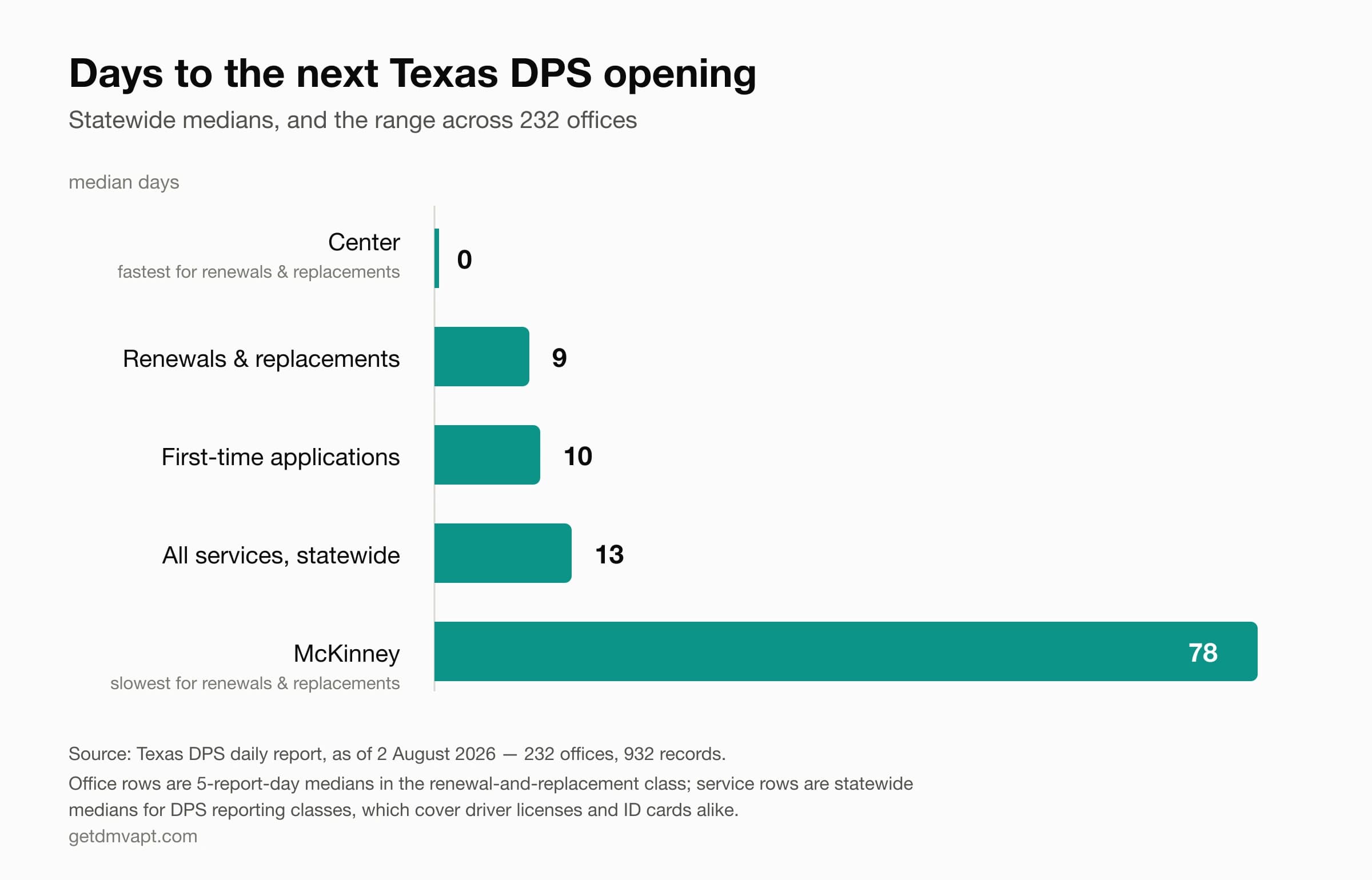
Days to the next opening across 232 Texas DPS offices, from the state's daily report, August 2, 2026.
The spread is the story. Two people applying for the same card on the same morning, forty minutes' drive apart, can be looking at a slot this afternoon or a wait until late October. First-time applications run roughly a day longer than renewals in the state's own report, though DPS groups services into broad classes rather than reporting ID cards separately. We publish current DPS lead times for every Texas office, updated daily from the same report.
Clock two: how long until the card arrives. Approximately two to three weeks. That figure is DPS's own, stated on both its ID card application page and its card mailing status page, and it is measured from the date of your transaction rather than from the day you booked. It does not change based on which office you visited, and it applies the same way to a first-time ID, a renewal and a replacement.
This clock matters less than its length suggests, though not to zero. You leave the office the same day with a temporary paper ID, and the permanent card follows in the mail. The paper temporary covers you at counters that accept a state ID; it is not the gold-star card, so if you are flying before it arrives, plan on another form of federal identification. Check the printed information on that temporary card before you leave the building. That is your last easy chance to catch an error, and an error means starting the two-to-three weeks over.
Where can you get a Texas ID card?
At any Texas driver license office. DPS operates more than 230 statewide and every one of them issues ID cards by appointment only. There is no separate DMV and no ID-only location, so the practical question is not where you can go but which office has an opening first.
The part most people skip: the important office isn't the closest one, it's the one with an opening, and the gap between those two answers is measured in weeks.
Mega Centers in Dallas, Houston, Austin, San Antonio and El Paso absorb the most demand and book the furthest out. Smaller offices thirty to sixty minutes outside those metros frequently show openings the big centers won't have for months. You can compare Texas DPS office locations city by city, right down to individual sites like the Carrollton Mega Center in the Dallas area.
If you're not sure which office is even yours, our guide to finding a Texas DMV near you walks through it. That is the single most valuable decision in this whole process: an hour of driving can be worth six weeks of waiting.
Jacob ran into exactly this in Austin.
"My Texas state ID had expired and I was about to start a new job. On my day 1 they required me to have a State ID or driver's license and it was part of my employment contract and also required for I-9 verification with USCIS. The earliest appointment anywhere in Austin was 45-90 days out and that meant I am not starting my job for another 2-3 months, which was just not happening. You guys have saved me and my life by helping me secure a next day Texas state ID appointment in flat 13 hrs, moreover in Pflugerville Mega Center which was sold out for almost 3 months for my request type…" — Jacob, Austin, TX · verified Trustpilot review
The Pflugerville Mega Center serves the Austin area from Travis County. Jacob's experience is his own, but the pattern behind it is in our data every day.
A Texas ID and a driver license are not the same card
They look nearly identical and are not interchangeable. Both are issued by DPS, both can be Real ID compliant, and both satisfy employment verification and voter ID. Only one of them authorizes you to drive, and you cannot hold a valid version of each at the same time.
The practical differences are narrow but they matter.
An ID card proves who you are. A driver license proves who you are and that the state has authorized you to drive.
Both can be Real ID compliant, marked by a gold star in the upper corner. That star is what matters at airport security, not whether the card says Driver License or Identification Card.

Real ID enforcement began May 7, 2025. A compliant state ID clears domestic security without a passport.
If flying is the reason you need this card, our guide to Real ID requirements for Texans covers what qualifies and what doesn't.
For employment paperwork, both cards do the same job. For voting, both work. For driving, only one does.
New to Texas? What changes, and how long you have
If you drive, you have 90 days to swap an out-of-state license for a Texas one. If you don't drive, no deadline applies to an ID card at all. Either way, surrendering a valid out-of-state license or ID waives the rule that one residency document must show 30 days in Texas.
Which card you need depends on whether you drive.
The driving clock. DPS counts it from the day you move, and it applies to a valid, unexpired license from another U.S. state, U.S. territory, Canadian province or qualifying country. After it runs out you need a Texas license to keep driving.
There is no equivalent clock for an ID card. Nothing requires you to hold one. You get it when you need photo ID: for work, for voting, for flying. The deadline above is about driving privileges, not identification, and plenty of guides blur the two.
One rule genuinely favors newcomers. Texas normally requires that one of your two residency documents proves a month's residence before it will issue anything. Surrender a valid, unexpired license or ID from another state and that requirement drops away. You still bring both documents; you just do not have to have been here first.
If you are swapping a license, not getting an ID. You surrender the out-of-state card and are issued the Texas equivalent. A valid, unexpired license from another U.S. state, territory or Canada usually waives the knowledge and skills exams, and DPS wants your vehicles registered in Texas before you apply. That is a different transaction from the ID card this guide covers, so book it as a driver license: our Texas driver license requirements guide has the document checklist, and first-time Texas driver license is the service to search for. A foreign license not issued in English or Spanish needs a certified translation before you go.
Whichever card you're after, the appointment is booked the same way, from the same scheduler, against the same availability.
The Election Identification Certificate is free, and most people don't qualify
There is a fourth card almost nobody writes about: the Election Identification Certificate. DPS issues it at no charge, and it exists for one purpose, voting.
The catch is who's eligible. You cannot get an EIC if you hold — or held within the last four years — a Texas driver license, a Texas personal ID card, a license to carry, a U.S. passport book or card, or a U.S. military photo ID. A photo citizenship or naturalization certificate disqualifies you too, and that one counts no matter how long ago it was issued.
So the EIC is for a specific person: someone with no photo ID at all who needs to vote.
To get one you must be a Texas resident, be eligible to vote here, bring documentation of U.S. citizenship and identity, and be at least 17 years and 10 months old. The form is DL-14C, and there's a Spanish version, DL-14CS.
It is booked the same way as everything else. DPS states that all driver license, identification card and election identification card services are by appointment only.
If you need photo ID for anything beyond the ballot box, the $16 ID card is the one you want.
Can you renew or replace a Texas ID online?
Renewals yes. Replacements too, but only if you still hold the old card. First-time cards almost never — with one exception that matters for the biggest group of ID applicants in Texas.
DPS keeps a separate eligibility list for ID cards, and it is worth reading rather than assuming, because the driver license list sitting next to it on the same page is stricter and gets quoted for ID cards constantly. To renew a Texas ID online or by phone, all four have to be true: you renewed that ID in person last time, it expires within two years or has been expired less than two years, you are 18 or older, and you are a U.S. citizen with a Social Security number on your record.
Notice what is not on that list. There is no upper age limit for renewing an ID card online — the under-79 cutoff belongs to driver licenses, as does the rule about Hazmat endorsements. If you are 80 and renewing an ID, the age is not what stops you.
The first-card exception: Texans 65 or older who are U.S. citizens and hold a Real ID compliant Texas driver license or CDL can voluntarily surrender it and apply for an ID card without visiting an office at all. That is the single most useful sentence on this page for anyone who has stopped driving. Everyone else applying for a first card does need the visit, because that is where documents are inspected, the photo is taken and thumbprints are captured.
Replacing a lost, stolen or damaged card costs $11, and the expiration date carries over unchanged. A replacement does not buy you more time. You may not need the office at all: DPS's Online Card Replacement works if you have your card number, date of birth, the last four of your Social Security number and the audit number from your most recent card. Lose the card and you lose the audit number with it, which is what sends most people back to an appointment.
Changing your address is its own transaction, separate from a renewal.
If you're not eligible to renew online, by phone or by mail, you're back to an office visit, which means back to the appointment problem.
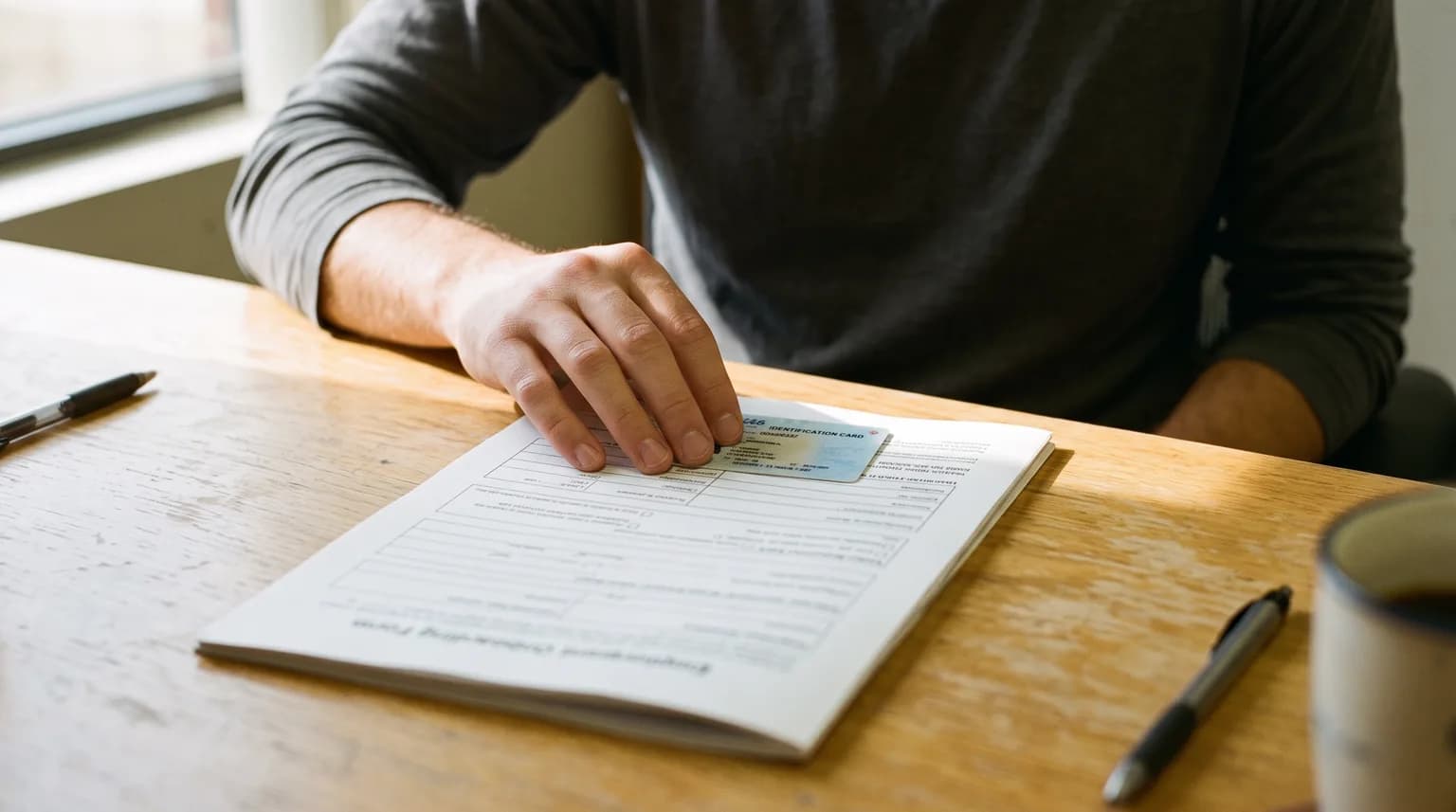
Form I-9 lists a state-issued ID card under List B, the identity documents employers accept from a new hire.
Why $29.99 beats refreshing the DPS site
Three ways to get an appointment. Three criteria that separate them: what it costs you in money, what it costs you in attention, and how fast it lands.
The official DPS scheduler is free and it's the only place appointments actually exist. Everything below still books through it. If your schedule is flexible and you don't mind checking repeatedly, this is the right answer and you should stop reading.
Alert services in this category tell you when a slot opens. You still have to be at your device to claim it, competing against everyone else who got the same alert.
Get DMV Appointments watches every Texas DPS office and books the slot the moment a match appears. One-time $29.99, with an automatic full refund if we don't book you within 7 days. Here's how Get DMV Appointments works, and the full Get DMV Appointments pricing.
Here's the math. If the next opening near you is 78 days out and you check twice a day hoping for a cancellation, that's 156 checks. The service costs less than most people's hourly rate for a few hours of attention, and it runs at 3 a.m., which you will not.
"Secured a renewal appointment in 3hrs, the appointment was 2 days out. The official scheduler showed no availability for 3 months in any nearby office for my service…" — Kristen, McKinney, TX · verified Trustpilot review
"They took less than a day to book an appointment for me! Honestly, the price is worth it for the peace of mind alone. Instead of constantly checking for an appointment, the website does all the searching for me. It saved me a lot of time and stress, and I didn't have to worry about missing an opening…" — Juliana, Dallas, TX · verified Trustpilot review
We are not affiliated with Texas DPS, and we submit through the same public scheduler anyone can use. We are just watching it constantly.
What to do next about your Texas ID card
If your card is expiring and you have no deadline, book directly at public.txdpsscheduler.com, look at offices outside your metro as well as inside it, and take the first reasonable date you see.
If you are up against something that will not move, whether a start date, a flight or an expiring card, the arithmetic changes. The gap between the fastest and slowest office for renewals and replacements is 78 days, and cancellations at the busy offices appear and disappear within minutes.
Disclosure: I'm on the team at Get DMV Appointments. We saw this problem in our customer data and built a way around it. Your time waiting for a slot to open is worth more than $29.99, and we monitor 24/7 so you don't have to.
Frequently Asked Questions
How much is a Texas ID card?
A Texas ID card costs $16 if you're 59 or younger and $6 if you're 60 or older. A replacement for a lost, stolen or damaged card is $11. A $1 administrative fee is already included in those amounts, and it is not charged for transactions conducted through the mail. A standard Texas ID card is valid for six years. Limited-term cards expire when your period of lawful presence expires, or one year after issuance if that period is recorded as "duration of status". The price does not change based on which office you visit or how far ahead you book — only your age on the day you apply moves it.
How do I get a Texas ID card?
Gather proof of U.S. citizenship or lawful presence, proof of identity, your Social Security number, and two documents proving Texas residency. Book an appointment at public.txdpsscheduler.com under 'Apply for first time Texas ID', then visit the office to have your photo taken, your thumbprints captured and your signature recorded. Appointments are required, because DPS does not take walk-ins for ID work. You leave the same day with a temporary paper ID, and DPS mails the permanent card in approximately two to three weeks.
What do I need to get a Texas ID card?
Four categories of proof: U.S. citizenship or lawful presence, identity, Social Security number, and Texas residency. Identity has three accepted routes: one Primary document, or two Secondary documents, or one Secondary plus two Supporting documents. Residency takes two separate documents, and one must show you have lived in Texas for at least 30 days. Everything must be an original or a certified copy. Certified copies must not be laminated, and photocopies are not accepted, so a document with all the right information on it can still be refused for being the wrong version of itself.
Where do I get a Texas ID card?
At any Texas driver license office. DPS lists more than 230 offices statewide, and all identification card services are by appointment only. Which office you choose changes your wait by weeks: Mega Centers in the big metros book out furthest, while smaller offices 30 to 60 minutes away often show much sooner openings. You are not restricted to the office nearest your home, and nothing about the card itself changes based on where you get it — the fee, the documents and the validity rules are identical statewide.
Can I get a Texas ID card online?
Usually not for a first card, with one significant exception. Texans 65 or older who are U.S. citizens and hold a Real ID compliant Texas driver license or CDL can surrender it and apply for an ID card entirely online, with no office visit. Everyone else applying for a first card appears in person, so identity documents can be inspected, a photo taken and thumbprints captured. Renewals can be done online if you renewed in person last time, the card expires within two years or has been expired less than two years, you are 18 or older, and you are a U.S. citizen with a Social Security number on record. If you do not meet all four, book the 'Change, replace or renew Texas ID' service on the DPS scheduler.
How do I renew my Texas ID card online?
Through the DPS online renewal system, if you meet all four of its conditions: you renewed that ID in person last time, it expires within two years or has been expired less than two years, you are 18 or older, and you are a U.S. citizen with a Social Security number on your record. There is no upper age limit on renewing an ID card online — the under-79 rule people quote applies to driver licenses, not ID cards. Renewal costs $16, or $6 if you are 60 or older. If you cannot use the online system, book the 'Change, replace or renew Texas ID' service on the DPS scheduler instead, and expect the same approximately two-to-three-week mailing wait.
How long does it take to get a Texas ID?
There are two clocks. Getting an appointment is the slow one: across 232 Texas offices the median wait for the next opening was 13 days as of August 2, 2026, ranging from same-day at the fastest office for renewals and replacements to 78 days at the slowest. DPS reports availability by broad service class rather than by ID cards alone. The second is delivery: you leave the office with a temporary paper ID, and DPS mails the permanent card in approximately two to three weeks. At the median that is roughly four to five weeks end to end, though a fast office can close the whole thing in two to three.
How do I get a replacement Texas ID card?
You may not need an appointment at all. If you still have the card — damaged rather than lost — you also still have its audit number, and DPS's Online Card Replacement handles it online. Lose the card and you lose the audit number with it, which is what sends most people to the scheduler, where the service is 'Change, replace or renew Texas ID'. Either way a replacement costs $11 and your expiration date stays the same, so replacing a card does not extend it. That trips people up: if the lost card was already close to expiring, you may be paying for a card that expires shortly afterward, and renewing instead is usually the better transaction. The replacement arrives by mail on the same approximately two-to-three-week timeline as any other Texas ID card.
What does a Texas ID card look like?
Nearly identical to a Texas driver license in size, photo and layout, but the front reads Identification Card rather than Driver License. A gold star in the upper corner means the card is Real ID compliant. That star is the part that matters at airport security and federal buildings, where a star-bearing Texas ID is accepted exactly the way a star-bearing driver license is. Without it, the card still proves who you are for everyday purposes but does not work as federal identification.
How much is a Texas ID for seniors?
$6 from your 60th birthday, for both new cards and renewals, compared with $16 for everyone 59 and younger. The senior rate is easy to miss, and nobody at the counter is obliged to point it out. It goes by your age on the day of the transaction, not the age you were when your previous card was issued, so someone renewing shortly after turning 60 pays the lower amount. The card is valid for six years either way.
Can you walk in for a Texas ID, or is it appointment only?
Appointment only. DPS states that all driver license, identification card and election identification card services require an appointment, so walking in without one is not an option for ID work. Appointments are booked free at public.txdpsscheduler.com. In practice this is what turns a short errand into a multi-week project: the constraint is not the twenty minutes at the counter, it is the wait for a slot, which across 232 offices runs a median of 13 days and stretches to 78 at the slowest office for renewals and replacements.
What is an Election Identification Certificate?
A free, voting-only photo ID issued by DPS. You do not qualify if you hold — or held within the last four years — a Texas driver license, a Texas ID card, a license to carry, a U.S. passport book or card, or a U.S. military photo ID. A photo citizenship or naturalization certificate also disqualifies you, with no time limit at all. So the EIC is for a narrow group: someone with no current photo ID and none in the recent past who needs to vote. The application is form DL-14C, and the minimum age is 17 years and 10 months.
Ready to Skip the Wait?
Stop refreshing the DPS website. Let us find and book your appointment in days, not months.
$29.99 one-time payment · Full refund guarantee